Related

The CrossFit Secret - Why It Sticks
People come to CrossFit for all kinds of reasons. To lose weight. To get stronger. To feel better in their clothes. To keep up with their kids. To prove something to themselves after a health scare or a hard season of life.
The reasons are as different as the people who walk through the door.
But here's what's interesting: somewhere along the way, something shifts.
And that shift is the secret.
From What You Can't Do to What You Can
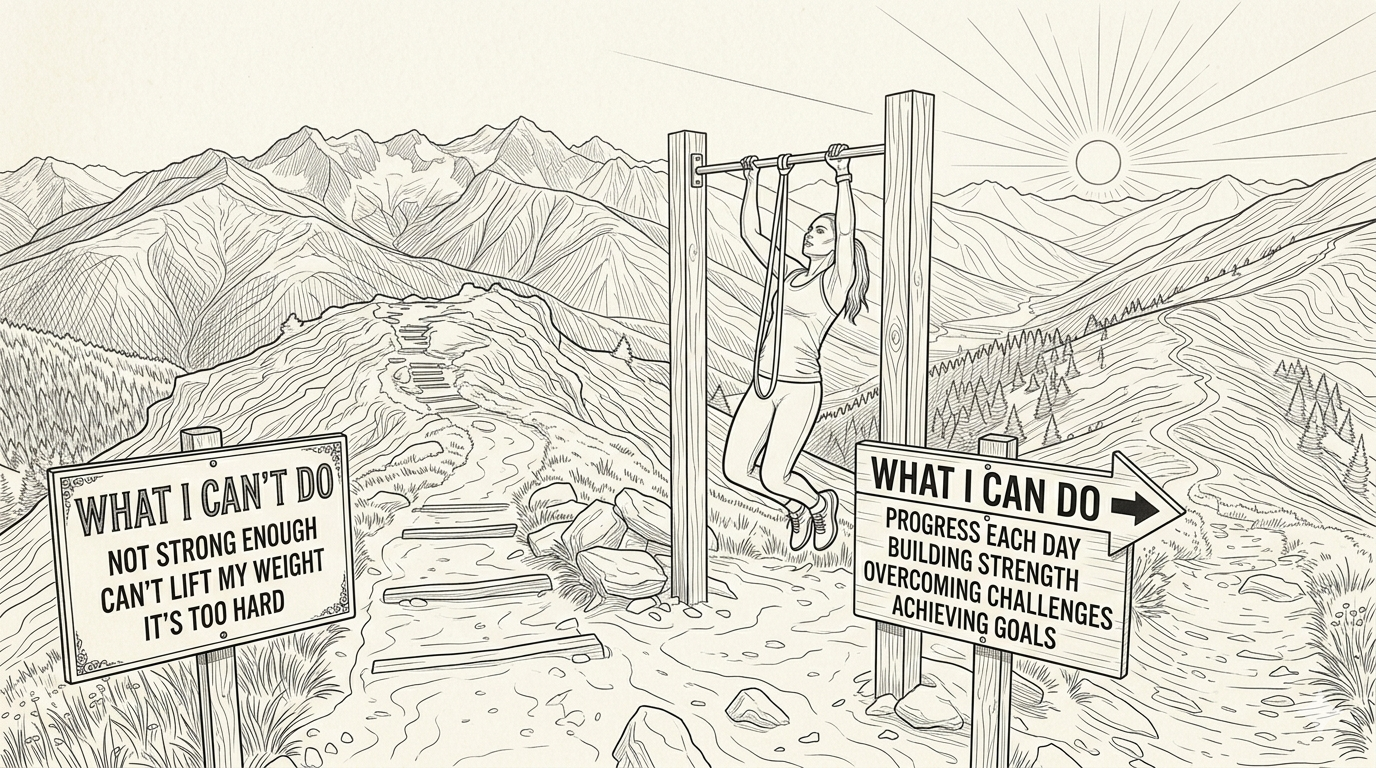
Most people start their fitness journey focused on what their body looks like or what it can't do yet. The number on the scale. The clothes that don't fit right. The things they avoid because they don't feel capable enough. But CrossFit has a way of quietly redirecting that focus.
It usually starts with something that seems impossible. The pull-up. You watch other people do them. Maybe you've never done one in your life. Maybe you tried once a long time ago and gave up. You start working the progressions: the banded pull-ups, the ring rows, the negatives. Weeks go by. And then one day, out of nowhere, you pull yourself over that bar.
And everything changes.
Not just because you did a pull-up. But because of the question that follows it.
What else can I do?
Then comes the rope climb. You look up at it and think there is no way. And then you do it. And you stand there for a second wondering who you are now and what else you've been wrong about yourself.
The floodgates open. What other limits have you placed on yourself that simply aren't true?
The Swagger
There's no other word for it.
When you start feeling yourself get stronger, more confident and more capable inside the gym, you carry it differently outside of it too.
It's not arrogance. It's the quiet confidence that comes from knowing what you're made of. From having done hard things repeatedly and come out the other side.
Suddenly it isn't all about your body's flaws. It's about what your body can do. And that is a fundamentally different relationship with yourself, one that tends to stick.
Deliberate Practice: The Other Reason People Stay
Here's something that surprises a lot of people about CrossFit. What starts as just showing up to sweat and check the box slowly becomes something more purposeful. You start paying attention to the stimulus of the workout. Why is it programmed this way? What is this supposed to feel like? What are you supposed to be working on? How can I refine my technique? How can I learn this new skill?
You start showing up with intention.
That's deliberate practice, and it's one of the most powerful forces in human performance.
Psychologist K. Anders Ericsson, whose research popularized the concept, found that what separates experts from everyone else isn't just the hours they put in. It's that they practice in a specific way, performing at a level slightly beyond what's currently comfortable, with clear goals and immediate feedback driving continuous improvement.
CrossFit is built for exactly this. Every workout has a stimulus. Every movement has a standard. Every class has a coach watching your mechanics and giving you feedback. And the constantly varied programming means you're almost always working at the edge of what you can currently do, which is precisely where growth happens.
The Flow State
Psychologist Mihaly Csikszentmihalyi spent decades studying why certain activities are so absorbing that people lose track of time entirely. He called it flow, because his research participants described the experience using the metaphor of being carried by a current. The flow experience came when the activity was difficult and involved some risk, when it stretched a person's capacity and provided a genuine challenge to their skills.
Csikszentmihalyi observed that if challenges are too low, boredom sets in. If they are too great, anxiety takes over. Flow lives in the channel between the two, where skill and challenge are balanced just right.
Sound familiar?
That's a CrossFit workout on a good day. The music is up, the clock is running, you're moving well and suddenly twenty minutes have gone by and you have no idea where they went. You weren't thinking about your to-do list or your stress or your body's flaws. You were just in it.
Where Kotler Takes It Further
If Csikszentmihalyi gave us the science of flow, Steven Kotler gave us the permission slip.
Kotler is a New York Times bestselling author and the Executive Director of the Flow Research Collective. He has spent decades translating the neuroscience of peak performance into language the rest of us can actually use and more importantly, apply.
His book Gnar Country: Growing Old, Staying Rad is one of the most energizing things you can read if you are a Masters athlete, or honestly anyone who has ever been told they are too old to be chasing this kind of progress.
The premise is simple and a little punk rock: Kotler, at age 53, decided to learn park skiing, jumps, tricks and all, using everything he knew about flow science and deliberate practice to see if the rules about aging and skill acquisition were actually true.
Spoiler: they weren't.
Gnar Country is about goals, grit and progression. It's an antidote for the weariness that creeps in when people start believing the story that their best years of learning and growing are behind them.
What makes Kotler's work so relevant for anyone training at Chalk Dog, especially our Masters athletes, is that he strips away the academic complexity and gets to the heart of it: flow isn't just for elite twenty-year-olds. Flow is the optimal state of consciousness where we feel our best and perform our best, and Kotler argues it is not only accessible at any age but is actually one of the most powerful tools available for peak performance aging.
He also makes a point that we see lived out on the floor every single day: the activities most likely to drive us into a flow state are challenging, social and creative, and the state itself produces feelings of mastery and control, which are two of the most positive feelings humans can experience.
A hard workout. A room full of people. A movement you are actively trying to get better at.
That's not just a CrossFit class. According to Kotler, that's the exact recipe for flow.
And here's what we love most about his message for anyone who has ever wondered if they are too old to be attempting a muscle-up, learning to double under or chasing a barbell PR: the brain changes that occur in the second half of life, if properly cultivated, can actually unlock new levels of intelligence, creativity and wisdom. Our physical skills begin to decline, yes, but we are also learning how to offset that decline in ways we never could before.
In other words, the Masters athlete who keeps showing up, keeps chasing hard things and keeps doing deliberate work isn't fighting aging. They're doing exactly what the science says works.
Gnar Country is our current book recommendation at Chalk Dog CrossFit. If you are in your 40s, 50s or beyond and you still have things you want to accomplish in the gym and in life, read this book. It will light a fire.
The Real Secret
So why do people stick with CrossFit?
Not because the workouts are easy. They're not.
Not because it's convenient. It requires showing up consistently and working hard.
People stick with CrossFit because it changes the question.
It moves you from how do I look to what am I capable of. From checking a box to pursuing something. From going through the motions to experiencing what it feels like to be completely absorbed in something hard and coming out stronger on the other side.
The pull-up was never really about the pull-up.
It was the moment you started believing in a bigger version of yourself.
That's the secret. And once you find it, you don't want to give it up.
Come find yours at Chalk Dog CrossFit.
References and further reading: K. Anders Ericsson, Ralf T. Krampe and Clemens Tesch-Römer, "The Role of Deliberate Practice in the Acquisition of Expert Performance," Psychological Review, 1993. Mihaly Csikszentmihalyi, Flow: The Psychology of Optimal Experience, 1990. Steven Kotler, Gnar Country: Growing Old, Staying Rad, Harper Wave, 2023. Flow Research Collective: flowresearchcollective.com

.png)

.png)
.png)